
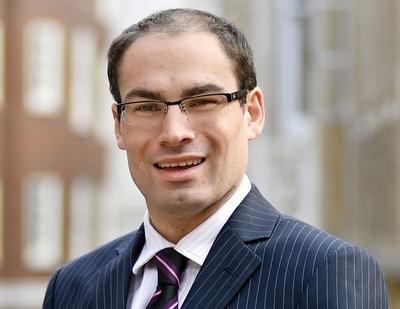
Alexander Brown KC, a commercial barrister elected to the Bar Council for 2027 to 2029, on breathing lessons from an opera singer, and his invitation to the commercial Bar.
At ten to two on Saturday afternoon, a room full of barristers sat with their eyes closed, breathing out as slowly as they could. “Like a spider spinning a web,” said a voice from the front.
This was “How to lose a case in 7 ways”, the session at Bar Conference 2026 on how to perform in court. That is what I teach, at Lincoln’s Inn and the Inns of Court College of Advocacy, so it was the one I’d been looking forward to most. My only quarrel was with the number. I know far more than seven ways to lose a case!
The voice at the front belonged to Jennifer Johnston, a mezzo-soprano who used to be a barrister, and she had earned the right to tell us how to breathe. At 25 she was left alone in the Court of Appeal, against her own head of chambers, with her knees shaking so hard that she clamped her hands to the desk. Every other performer is taught how to use their voice and their breath, she said. Barristers never are. Those of us who teach advocacy should take the hint.
Her co-presenter was Bibi Badejo, a family barrister and advocacy coach. Learn your first three lines and your last three, she told us, so that you end on something stronger than an offer to assist the court further. The textbooks call this primacy and recency. Bibi calls it dropping the mic. I have yet to see a mic dropped in the Commercial Court, but I live in hope.
Bar Conference is the one day in the year when the whole Bar is in the same building, and I get to hear how everyone else does the job. I’ve just been elected to the Bar Council, so it was a good year to listen to my colleagues and learn as much as possible.
That morning, the first session had been on artificial intelligence (AI), which is the hottest topic at the Bar and deserves to be. I’m an enthusiast, and I already use AI in practice quite a lot. Dr Kamel El Hilali, a specialist from UNESCO, warned us about invented citations and fake quotations. Barrister Saara Idelbi compared AI to a coach, who doesn’t need to be the athlete to make the athlete better.
I liked that analogy, because somebody still has to be the athlete. And that’s us.
I’m a commercial barrister, which means contracts, banks, and businesses that have fallen out with each other. It also means a lot of paper. Opinions, witness statements, pleadings, skeleton arguments. AI is getting very good at paperwork. But what it can’t do is stand up in court. It can’t cross-examine a witness who has just changed their story, and it can’t keep going in the Court of Appeal while its knees shake.
Oral advocacy is what the Bar is best at. As machines take on more of the paper, what we do on our feet matters more. The morning was about the machines, and the afternoon was about us.
Even that morning, Kirsty Brimelow KC, the Chair of the Bar, had moved in her speech from AI to the skills that make great barristers. They are, she said, “undeniably human”: judgment, critical thinking, adaptability and connection. Oral advocacy demands all four at once, and in public.
A jury is undeniably human too, and this year the Bar had to stand up for it. The government began the year planning judge-only trials for a swathe of Crown Court cases. In October, after the Bar Council’s “Justice needs juries” campaign, ministers dropped the centrepiece of that plan. It was seen off, the Chair said, by “analysis and advocacy”, and by barristers with the courage to speak out.
Michael Mansfield KC, who calls the jury “a golden nugget”, warned before lunch that the argument isn’t over: the government’s Bill still lets a judge alone try fraud cases that are “lengthy and complex”. His answer was the Hillsborough inquests, where a jury sat for two years and returned 14 determinations. “They were quite capable,” he said.
Lengthy and complex is what I do all day, so you might expect a commercial silk to side with the doubters. I don’t. I’ve never addressed a jury, but making a complicated case simple is the advocate’s job in any court. If the tribunal can’t follow it, look first at counsel.
We are barristers before we are commercial barristers, and the jury is our business too. I sit on the Bar Council's International Committee, which promotes the Bar abroad, and what we promote is the whole system, juries included. Whenever the Bar has to stand up for it, I’d love to see the commercial Bar on its feet.
So if you’re a commercial barrister, get involved. Talk to someone whose practice looks nothing like yours. As the Chair put it, “we lawyers from very different disciplines have a lot to learn from each other”.
A machine can write. It can’t stand up in court, and it can’t stand up for a jury. That part is ours.
Alexander Brown KC practises in commercial litigation and international arbitration at One Essex Court. He has appeared in the Supreme Court, the Court of Appeal and numerous High Court trials.